Tokemak
 Autopools: ETH vs Stablecoin Pools
ETH-focused Autopools pursue yield measured in ETH, while stablecoin Autopools use dollar-linked assets. Both automate allocation within each vault’s eligible destinations. Tokemak’s Autopools operate under Auto Finance following the September 18, 2025 rebrand. The choice depends on the exposure you want to retain, the underlying assets and markets you’re willing to hold, and the vault’s network.
A vault’s base asset determines its accounting and compounding unit. A deposit made with another token can be swapped into that asset, so the token you supply doesn’t establish the exposure you’ll keep.
ETH and stablecoin mandates
ETH-focused vaults
ETH-focused strategies include liquidity positions involving liquid staking tokens (LSTs) and liquid restaking tokens (LRTs). Tokemak’s September 2024 Autopilot AMA described autoETH for ETH LSTs, autoLRT for ETH LRTs, and balETH for ETH LSTs and LRTs on Balancer. The deployment documentation lists these three vaults on Ethereum mainnet. Their permitted assets and destinations distinguish the strategies even though all three target ETH exposure.
ETH denomination leaves the position exposed to changes in ETH’s dollar price. An LST or LRT trading at a discount to its ETH backing can also affect the underlying liquidity position. Correlated pairs generally have lower impermanent-loss exposure while their price relationship holds, but losses remain possible if their prices diverge.
Stablecoin vaults
Documented stablecoin options include autoUSD on Ethereum and baseUSD on Base, announced as live on May 23, 2025. Depending on the vault’s configured destinations, stablecoin strategies can earn lending interest, trading fees, and underlying protocol incentives.
Stablecoin exposure targets dollar-linked assets, with risks determined by the actual coins and markets the vault can hold. A loss of a stablecoin’s peg or a loss at a destination can reduce the position’s value. Comparing stablecoin vaults therefore requires their asset and destination lists as well as their quoted yields.
Allocation within each vault’s limits
Autopilot can adjust positions within an Autopool’s eligible set. A protocol-wide integration doesn’t make that destination available to every vault, and inclusion in a vault’s set doesn’t mean it always receives capital.
| Rebalance stage | Allocation control |
|---|---|
| Proposal | The offchain solver proposes a change among eligible destinations using market information. |
| Validation | The onchain Strategy contract checks the proposal against the Autopool’s constraints. A rebalance must satisfy those checks before execution. |
| Execution | An accepted rebalance changes the underlying positions. The Autopool’s receipt tokens continue to represent shares in the vault. |
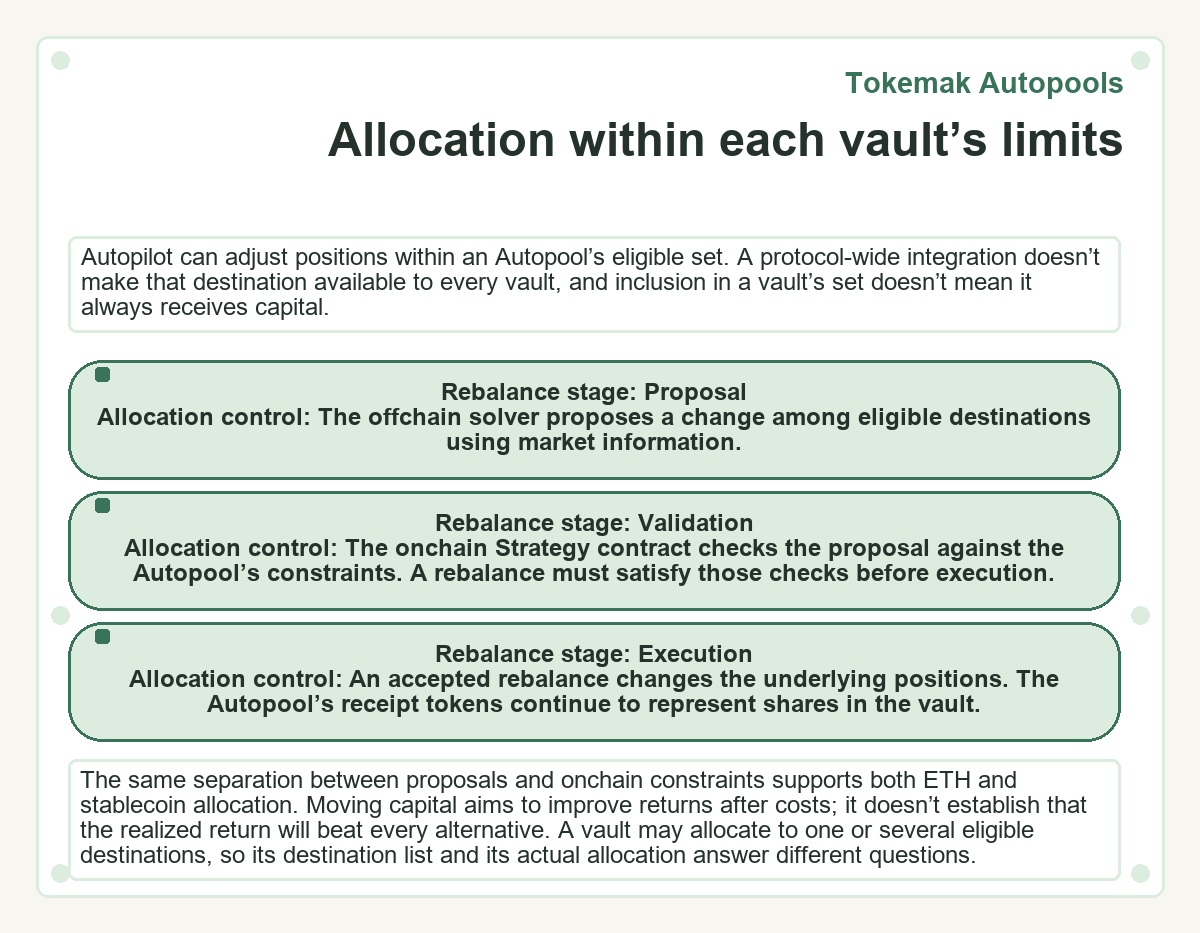
The same separation between proposals and onchain constraints supports both ETH and stablecoin allocation. Moving capital aims to improve returns after costs; it doesn’t establish that the realized return will beat every alternative. A vault may allocate to one or several eligible destinations, so its destination list and its actual allocation answer different questions.
Yield units, incentives, and costs
An ETH-denominated return and a stablecoin-denominated return measure performance in different assets. Their percentages alone can’t establish which position delivers the larger dollar gain. Compare rates over the same period and retain the distinction between the vault’s base-asset performance and changes in that asset’s market value.
Destination rewards are automatically compounded into the Autopool strategy. Additional pool incentives can have separate staking and manual-claim requirements where they’re offered. A comparison should distinguish those incentives from the underlying yield the vault reinvests.
Auto Finance’s app currently states that Autopools charge no management, performance, deposit, or withdrawal fees . Network gas and swap slippage remain separate costs. The technical documentation describes configurable fees, so a documented fee mechanism doesn’t establish an active charge for a selected vault.
Redemption liquidity and exit value
Autopool deposits have no lockup or cooldown, but redemptions remain subject to onchain liquidity. Receipt tokens staked for pool incentives must be unstaked before those shares can be redeemed. The separate lock for staking AUTO into sAUTO doesn’t apply to Autopool deposits.
The documented ETH Autopool architecture uses different valuations for reporting, deposits, and withdrawals. An exit larger than the idle base-asset balance may require removing liquidity from destinations and swapping other assets. Those trades can cause slippage, so a displayed portfolio value isn’t a guaranteed redemption amount.
For two vaults with similar quoted yields, the network, destination liquidity, and size of the intended exit can change gas costs and expected proceeds. Compare the selected vault’s redemption estimate and minimum output alongside its exposure and yield.